Description:
Our Daily Market Indicators section offers various daily updated indicators as listed below. All of them are updated daily for members , some of them are also updated daily for visitors.
Indices |
Trend Indicators |
Breadth Indicators |
|
|
|
| |
|
|
Oscillators |
Contrarian Indicators |
Sentiment Indicators |
|
|
|
| |
|
|
) Updated daily for Members only
all other indicators also daily updated for visitors
|
|
|
|
|
 |
|
Dow Jones Industrial Average Daily - (updated daily for members only) |
|
|
|
|
|
 |
|
 |
|
S&P 500 Index Daily |
|
|
|
 |
|
Trend Trader Index Daily - (updated daily for members only)
The Trend Trader Index calculates the simple moving average of the daily high and daily low price of the S&P 500 over the past 20 days. A short term uptrend exists if the S&P 500 is trading above the 20 day moving average line and a short term downtrend is given if the S&P 500 is trading below the 20 day moving average line. Additionally the direction of the simple moving averages could also give additional information about the trend direction. |
|
|
|
|
|
 |
|
 |
|
Global Futures Trend Index Daily - (updated daily for members only)
The Global Futures Trend Indicator calculates the amount of stocks listed on NYSE which are reaching weekly new highs or weekly new lows. As long as the gauge of this index stays above the 60% level there is a solid bullish trend in progress. |
|
|
|
|
|
 |
|
 |
|
Modified MACD Daily - (updated daily for members only)
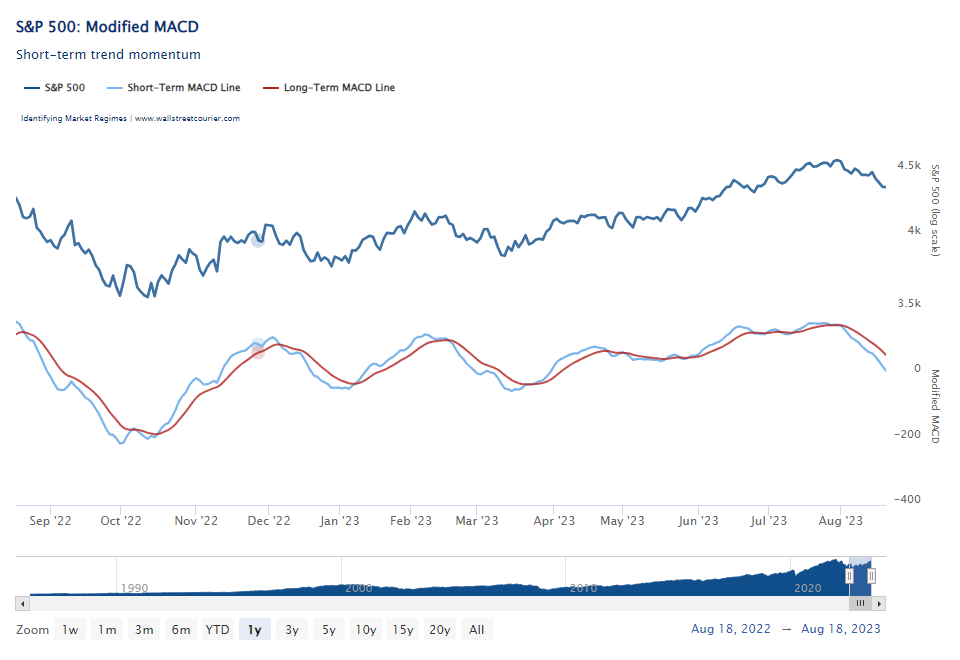
Imagine if everybody would know the tommorows' lottery numbers, then the gain is less than the bet! The same is true with common indicators everybody would follow. The Moving Average Convergence-Divergence (MACD) is one of the most effective trend indicator. MACD uses two exponential moving averages of the underlying market (S&P 500) to identify a trend.
WallStreetCourier uses a slightly different algo (adaptive moving averages including zero-lag momentum) for calculating the MACD. In using a zero-lag momentum within our MACD, this magnificant indicator nearly has no lag compared to traditional MACDs! |
|
|
|
|
|
 |
|
 |
|
Modfied McClellan Indicator Daily - (updated daily for members only)
This indicator is derived from the daily net advances, the number of advancing issues less the number of declining issues. By applying 2 exponential moving averages (short and longer one) of net advances this is a perfect momentum as well as breadth indicator. The McClellan Oscillator is a momentum indicator that works similar to MACD. The McClellan is above and below the zero line as the moving averages converge, cross and diverge. Investors should watch out for signal line crossovers, centerline crossovers and divergences between the market and the McClellan Oscillator to generate signals. WSC used a slightly different formula to calculate the McClellan Oscillator. |
|
|
|
|
|
 |
|
 |
|
Advance-/Decline 20 Day Momentum Daily - (updated daily for members only)
This center oscillator measures the advancing stocks and declining stocks on a 20 days basis. This indicator is a leading indicator as it leads the price move. The bigger the difference between the current price and the price 20 days ago, the higher the value of this oscillator. When the indicator is above 0, the percentage price change is positive (bullish). When the indicator is below 0, the percentage price change is negative (bearish). This indicator is especially reliable when a new high or low of the market is not confirmed by momentum. |
|
|
|
|
|
 |
|
 |
|
NYSE Volume Daily |
|
 |
|
 |
|
Upside-/Downside Volume Index Daily - (updated daily for members only)
This indicator is calculated by dividing the daily upside and downside volumes by the daily total volume. If prices move steadily upward (strong uptrend) with strong volume, this indicates that buyers are accumulating shares. A healthy market should be supported by strong up volume. If not there is a negative divergence between the market and breadth. This could happen, if only heavy weighted stocks in an index are pushing the market higher but the majority of small weighted stocks are already being sold by investors. By separating the up volume from the down volume, investors can get an insight about the future direction of the given index or market. Divergences between the market and volume should be monitored closely as a trend reversal could be ahead! |
|
|
|
|
|
 |
|
 |
|
9-to-1 Up-/Downdays - (updated daily for members only)
This indicator is based on the volume of all NYSE-listed stocks that go up or down on a given day, expressed as a percentage of the total volume of all stocks that rose or fell on that day. A "Nine-To-One Up Day" occurs when this ratio is 90% or higher on a given day. According to Martin Zweig, who helped to develop this indicator several decades ago, such a huge imbalance of up volume over down volume "is a significant sign of positive momentum or if it is a 90% down day it is a significant sign of negative momentum. |
|
|
|
|
|
 |
|
 |
|
NYSE New Highs - New Lows Daily
This indicator shows new highs and new lows made on Nyse. |
|
|
|
 |
|
Advance-/Decline Line in Percent Daily
The Advance Decline Line is a breadth indicator based on daily net advances made on Nyse, which is the number of advancing stocks less the number of declining stocks. Net advances are positive when advances exceed declines and negative when declines exceed advances. The Advance-/Decline Line rises when there are more net advances and falls when there are more net declines. The Advance-/Decline Line should confirm an advance or decline of the S&P 500. A bullish or bearish divergence in the Advance-/Decline Line compared to the S&P 500 could lead to a trend reversal. |
|
|
|
 |
|
Upside-/Downside Volume Line in Percent Daily
The Upside-/Downside Volume Line in Percent is a breadth indicator based on weekly net volume, which is the volume of advancing stocks less the volume of declining stocks. Net advancing volume is positive when advancing volume exceeds declining volume and negative when declining volume exceed advancing volume. The Upside-/Downside Volume Line in Percent rises when there is more net advancing volume and falls when there is more net declining volume. The Upside-/Downside Volume Line in Percent should confirm an advance or decline of the S&P 500. A bullish or bearish divergence in the AdvanceUpside-/Downside Volume Line in Percent compared to the S&P 500 could lead to a trend reversal. |
|
|
|
 |
|
Arms Index (Trin) Daily
The Short Term Trading Index was invented over 30 years ago by Richard Arms and is also known as ARMS Index. It is calculated by dividing daily advancing issues by daily declining issues and daily advancing volume by daily declining volume. The first result is then divided by the latter and the result is the TRIN. If the index is above one, the average volume of stocks that fell on the NYSE was greater than the average volume of stocks that rose and vice versa. But it is most confirmative when it reaches extremes. This indicator rises sharply when the market is most depressed and selling is climaxing, and falls to very low levels during buying frenzies. |
|
 |
|
 |
|
Arms Index (Trin) Daily - 10 SMA - (updated daily for members only) |
|
|
|
|
|
 |
|
 |
|
Upside-/Downside Volume Ratio Daily - (updated daily for members only)
The Upside-Downside Volume Ratio is a banded oscillator. It is calculated by dividing the volume of advancing issues by the volume of declining issues, using daily NYSE data. If the volume of advancing issues is reaching a predefined level, this indicator is flashing an overbought signal or the other way round. |
|
|
|
|
|
 |
|
 |
|
Advance-/Decline Ratio Daily - (updated daily for members only)
The Advance-Decline Ratio is a banded oscillator. It is calculated by dividing the number of advancing issues by the number of declining issues using daily NYSE data. If the advancing issues are reaching a predefined level, this indicator is flashing an overbought signal or the other way round. |
|
|
|
|
|
 |
|
 |
|
Smart Money Flow Index Daily - (updated daily for members only)
The Smart Money Flow Index is calculated by taking the action of the Dow in two time periods: the first 30 minutes and the close. The first 30 minutes represent emotional buying, driven by greed and fear of the crowd based on good and bad news. There is also a lot of buying on market orders and short covering at the opening. Smart money waits until the end and they very often test the market before by shorting heavily just to see how the market reacts. Then they move in the big way. These heavy hitters also have the best possible information available to them and they do have the edge on all the other market participants. Whenever the Dow makes a high which is not confirmed by the SMI there is trouble ahead or the other way round. |
|
|
|
|
|
 |
|
 |
|
Daily Put/Call Ratio All CBOE Options - Daily 10 SMA - (updated daily for members only)
The buying and selling activity for puts and calls can be used to help gauge investor sentiment in the market. The put call ratio measures the relationship between the numbers of puts being bought versus calls being bought. This indicator refers to All CBOE (Chicago Board of Exchange) Options. High put/call ratios are often indicative of excessive pessimism and thus of large amounts of money on being at the "sidelines." Conversely, low put/call ratios indicate a point at which there is so much optimism that very little money is left to push the stock or index higher. |
|
|
|
|
|
 |
|
 |
|
Put/Call Ratio All CBOE Options Daily |
|
 |
|
 |
|
Odd-Lot-Short-Sales Daily
This indicator shows the prevailing sentiment of the small investor. They are usually wrong at market tops and market bottoms. |
|
 |
|
 |
|
Odd Lot Differential Index Daily
The Odd Differential Index is a market sentiment. This index is simply calculated by subtracting the daily or weekly odd-lot sales from the daily or weekly odd-lot purchases. High readings appear near market tops and minus readings near bottoms. Introduced by Wall Street Courier, the Odd -Lot Differential Index indicates the market sentiment of small investors who purchase less than 100 shares of a stock. These market participants are usually wrong about the direction of the market and this indicator is therefore considered to be a contrary opinion sentiment indicator. |
|
|
|
 |
|
WSC Capitulation Index Daily - (updated daily for members only)
The WSC Capitulation Index is calculated according to a proprietary formula. It shows bottoms when the so called "crowd" gets too bearish. It does not appear very often but it is extremely reliable when the market is at a turning point. It prevents long-term investors from buying at the wrong time and works especially well for option traders because of its incredibly perfect timing. Unfortunately this indicator does not tell you when to sell. Set yourself a limit if you trade options, or use trailing stop-loss orders for your trades.
| |
Signals: |
• |
Bullish: Low readings or drop of the WSC Capitulation Index by half of its rise |
| |
|
• |
Bearish: Rising WSC Capitulation Index |
|
|
|
|
 |
|
Volatility Index Daily - VIX
The Chicago Board Options Exchange Market Volatility Index is a popular measure of the implied volatility of S&P 500 index options. Often referred to as the fear index or the fear gauge, it represents one measure of the market's expectation of stock market volatility over the next 30 day period. If the market makes a new high and the VIX does not make a new low, caution is warranted. |
|
 |
|
 |
|
Global Futures Time Premium Index Daily - (updated daily for members only)
This indicator shows the spread between the S&P 500 cash index and the nearest S&P 500 futures contract (premium). The bold lines are the futures contracts with the highest and lowest premiums measured in history. If the premium is trading near the upper line or above, investors are extremely bullish. The reverse is true if the premium moves near or below the lower line. |
|
|
|
|
|
 |
|
 |
|
Futures Premium Daily
This indicator shows the spread between the S&P 500 cash index and the nearest S&P 500 futures contract (premium). If the premium is trading above 0, investors are extremely bullish. The reverse is true, if the premium is trading below 0. |
|
 |
|
 |
|
Top |
|
 |
|
 |
|
|
|
 |
|
 |
|
|
|
 |
|